
Democracies Under Pressure. Authoritarianism, Repression, Struggles
Table of contents
- Introduction
- Reimagine Democracy
- Austeritarianism reveals the limits of neoliberalism
- When trade agreements undermine States’ ability to respond to ecological and social emergencies
- Equality: a thwated passion
- No More Business as Usual: The Rise of the Coalition Between State, Corporations and Human Rights Under Authoritarian Neoliberalism (in the Times of Corona)
- The 1970s and the counteroffensive of authoritarian liberalism versus democracy
- Regulating Corporate Political Influence on Public Opinion
- Citizen Associations in Social Movement: Taking Back the Offensive
- Can Twenty-First Century Fascism Resolve the Crisis of Global Capitalism?
- The 2010s: the rise of authoritarian and ultraconservative governments
- The sad banality of the antiterrorist exception
- Law and Order in France: a Cocktail of Colonial Violence and Neoliberal Restructuring
- How and Why Calls to Boycott Israeli Products Became Criminalised in France
- With the rise of hypercapitalism and strongman politics, human rights defenders are increasingly at risk
- A Putschist Attack on Our Continent
- The Deep Rifts in Bolivia’s Electoral Crisis
- Capitalo-Technocracy: Fifty Shades of Surveillance
- Protecting Civic Spaces
- Police Repression and Criminalization of Indigenous Resistance in Canada
- Democratic Spaces and Telecommunications Infrastructure: Internet Operators as Political Figures
- Freedoms of Civic Organisations Under Threat. Findings, consequences and strategies
- Digital and Legal Self-Defence Against Repression
- Open letter from Chile’s First Line (Primera Línea)
- Reinventing our Militant Communities: Political Identity and Forms of Action
- Could the Police be Abolished? A Hot Topic in the USA
- Feminism and Abolitionism: Political Perspectives
- "Protest democracy" : how African on-going social movements are redefining democracy and (re)inventing the future
- The Challenges of Fighting Authoritarianism in Africa
- Is Another World Still Possible ?
- Debtors of the World Unite
- Can Municipalism Breathe New Life into Democracy?
Open letter from Chile’s First Line (Primera Línea)
This text is an extract from an open letter written by militants of La Primera Línea, the “first line” of the powerful social movements that broke out in Chile in late 2019. They relate their experiences during the uprisings in Chile and discuss the current challenges faced by movements for social change.
[…] The first night of citywide rioting [18 October 2019] was followed by a week of peaceful protests that shared the streets with flaming barricades, looted stores and bands of masked youth throwing rocks and Molotov cocktails at the police. In response to widespread unrest, the government declared a state of emergency and called in the military to patrol the streets. The military promptly implemented a curfew and suspended the right to assembly for 90 days.
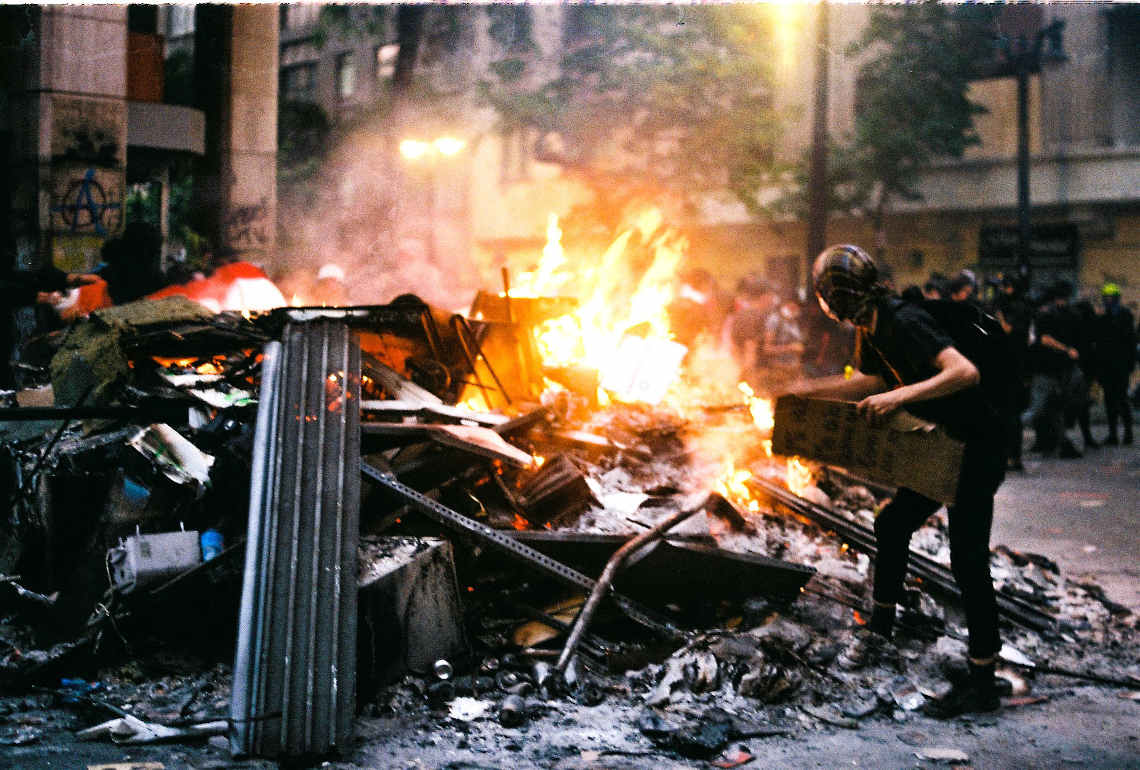
This was the first time that the military had been called into the streets since the last dictatorship. And the largest protests in Chilean history took place in response. Chile is considered a democratic country, but ironically, its largest protests were held during a time when protests were deemed illegal. While many organizations called for demonstrations, these protests erupted spontaneously; as people heard crowds gathering, they stepped out of their homes to join them. Initially, peaceful protests were organized throughout the city: people would bring signs, bang pots and pans, and chant in the streets. However, these protests were inevitably dispersed by the police with water cannons and tear gas. Videos of police brutality and human rights violations started to make the rounds on social media: police beating people in the streets and accounts of police officers and military personnel torturing and sexually assaulting detained protesters. Human rights groups conducted daily rallies against human rights violations and the United Nations sent a committee to investigate reports of police brutality and torture.
Ultimately, official complaints and investigations into human rights violations have dragged on for years. The only meaningful response to these human rights violations was to maintain a state of conflict with the police. The only protests that could last more than 30 minutes were the ones using barricades and relying on people willing to prevent the police from crushing the crowds, while guaranteeing everyone’s right to free assembly and free speech. Baquedano metro station, right below Plaza de la Dignidad (Dignity Square), was where the police deployed crowd control measures and tortured protesters. The precinct police station was rendered inoperational after protesters barricaded the entrance with stones and rubble. This wave of the protest came to be known as la primera línea, “the first line”, composed of rock-throwing and shield-bearing youth; followed by the second line of protesters pointing lasers; then a third line of protesters with spray bottles and water jugs to treat and neutralize tear gas; and finally, a fourth line of street medics who would carry away injured protesters and provide first aid.
These team-based roles enabled the rise of a varied protest culture in the course of the following months —from dancing Pikachus and street performances, to new chants and marching bands— all gathering every Friday in Plaza de la Dignidad. Those who had never fathomed confronting the police could join the first line if they wanted and try to hit a cop with a rock, or get practice in extinguishing tear gas. Years ago, it was unimaginable that the so-called encapuchados —once thought of as being either undercover police officers or reckless delinquent youth— could ever become the heroes of a social movement. Yet after 18 October, countless organizations hosted fundraisers for the legal and medical fees of folks on the first line. Most surprisingly, a group from the first line was invited to speak on police brutality at a Latin American human rights conference. Those who came to the square to sell empanadas, water, or beer would frequently end up by giving out free food and drinks to people geared up to step up to the first line.
In the beginning, we were scared and most concerned about the widespread looting and arson that set metro stations and office buildings ablaze. Rumors proliferated that the police was behind these incidents, attempting to make the protesters look bad in order to justify a military takeover of the country; or that it was criminalized gangs taking advantage of the protests to rob ATMs, pharmacies, and grocery stores. Although months have passed, we still don’t know who was responsible for the different incidents. But this attempt to suppress the protests by sowing fear of a military takeover or organized criminal activity did not scare people off the streets — nor did the heavy-handed military response to destruction of property have the intended effect. On the contrary, the military’s repression of peaceful protests only inspired more acts of self-defense, as protesters erected barricades to block military vehicles and used stones and bricks to keep them at a distance. As more stores were looted —not for commercial goods but for material to build barricades—anyone who attended a protest in good faith would agree that the most forms of destruction of property could not be qualified as ’rampant delinquency’.
At this uncertain and frightening time, many hoped that the unrest in Chile would reach a swift conclusion: that the president would resign, a constitutional assembly would form, and that together we could create a “new normal” where we could live with dignity. However, there is no such new normal in these times: [...] the crisis persists —squashed between emergencies and flashes of normality— but only under times of emergency are people no longer afraid to act out on their shared indignation and decide how they actually want to live.